
Unlock Project Potential with Expert Commercial Architectural Feasibility Studies
Before committing time, budget, and resources to a commercial development project, one crucial step can determine whether your investment moves forward successfully: a professional feasibility study. A commercial architect plays a vital role in this process by evaluating the practical, financial, technical, and regulatory viability of your proposed development.
Whether you are planning an office conversion, retail space, mixed-use development, commercial extension, warehouse transformation, or property redevelopment, working with an experienced commercial architect can help you identify opportunities, reduce risk, and make informed decisions from the outset.
What Is a Commercial Architectural Feasibility Study?
A feasibility study is an early-stage assessment designed to determine whether your commercial project is achievable and commercially worthwhile. Rather than moving straight into design and construction, a commercial architect analyses the site, planning constraints, budget expectations, spatial possibilities, and development objectives.
This strategic process helps clients understand project limitations and uncover solutions before significant investment begins.
How a Commercial Architect Adds Value to Feasibility Studies
Site Assessment and Development Potential
A commercial architect evaluates the site’s physical characteristics and explores how the available space can be used effectively. Factors such as access, surrounding infrastructure, environmental conditions, and site dimensions all influence the viability of a project.
This analysis can reveal opportunities to maximise floor area, improve operational efficiency, and increase long-term return on investment.
Planning and Regulatory Guidance
Navigating planning policies and building regulations can be complex. Commercial architects assess local planning requirements and identify possible challenges early in the process.
By understanding development restrictions, permitted opportunities, and compliance obligations, businesses can avoid unnecessary delays and costly redesigns.
Concept Development and Space Optimisation
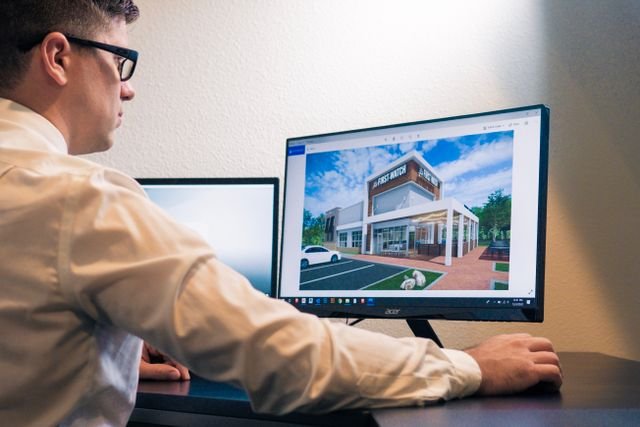
Feasibility studies often include conceptual layouts and design options that demonstrate what may be possible within the project scope.
Commercial architects create strategic concepts that balance functionality, aesthetics, business objectives, and user experience while ensuring practical implementation.
Budget Awareness and Cost Efficiency
An experienced architect helps align project ambitions with realistic budgets. Early cost awareness reduces financial uncertainty and supports smarter decision-making.
Feasibility planning can identify cost-saving opportunities, improve resource allocation, and minimise unexpected expenditure later in development.
Risk Reduction and Better Investment Decisions
One of the greatest advantages of a commercial feasibility study is reducing uncertainty. Architectural insight provides a clearer understanding of project risks before substantial commitments are made.
This allows property owners, developers, and investors to proceed with confidence.
Key Benefits of Commercial Architectural Feasibility Services
- Early identification of project opportunities and constraints
- Improved planning approval readiness
- Smarter space utilisation strategies
- Better budget forecasting and cost management
- Reduced project risk and development uncertainty
- Enhanced long-term commercial value
- Faster and more informed decision-making
Ideal Projects That Benefit from Feasibility Studies
Commercial architectural feasibility studies are valuable for:
- Office conversions
- Retail developments
- Commercial extensions
- Mixed-use developments
- Industrial and warehouse upgrades
- Property redevelopment projects
- Loft and space conversion opportunities
- Business expansion planning
Questions to Ask Before Hiring a Commercial Architect
1. Do you have experience with projects similar to mine?
Ask for examples of comparable commercial developments and outcomes.
2. What does your feasibility study include?
Ensure the service covers planning review, concept options, site analysis, and project recommendations.
3. How do you approach planning permissions?
Understanding their planning strategy can help reduce future delays.
4. Can you provide estimated project timelines?
Timelines help establish realistic expectations and improve project planning.
5. How do you manage project budgets?
Look for architects who integrate cost awareness into design decisions.
6. Will you coordinate with consultants and contractors?
Integrated project management often creates a smoother development process.
7. What challenges do you foresee for my project?
An experienced architect should identify risks and suggest practical solutions.
8. How will you maximise the value of my property?
This question reveals their strategic and commercial thinking.
Start Your Project with Confidence
Commercial feasibility studies provide the insight needed to move forward with clarity and confidence. By partnering with an experienced commercial architect, businesses can evaluate opportunities, minimise risk, and create a stronger foundation for successful development.
For expert guidance and tailored conversion solutions, visit The Loft Conversions